What Is Reiki?
Reiki is one of those things that can sound a lot more complicated than it actually is.
Reiki is a Japanese spiritual and energy practice rooted in the
work of Mikao Usui, who developed Usui Reiki Ryoho in Japan in the early 1920s.
The word Reiki is commonly translated as “universal life energy.” In the traditional understanding of Reiki, this energy is something that exists within and around us, and a practitioner uses specific practices—including meditation, hand positions, and hands-on or hands-above-the-body treatment—to support the body's natural capacity for
balance and healing.
That is the traditional foundation.
But here's what really interests me the most.
We live in a time where we're
learning more about the relationship between the body, the brain, our emotions, attention, stress, and
the nervous system.
We already know that our experiences don't happen in separate boxes.
What we think, feel, sense, and experience in our environment can affect how we feel in our bodies—and our bodies are constantly sending information back to us.
Reiki gives us a way to slow down enough to notice some of
that information.
You may walk into a room and immediately feel something is off.
You may spend time with someone and leave feeling completely drained.
You may get a feeling you can't explain, or notice tension in your body before your conscious mind understands why it's there.
Your body is communicating with
you all the time.
After working with Reiki for more than eight years, I've come to see the
practice as more than simply
placing hands on someone and
“sending energy.”
I see it as a practice that can help create the space for you to
become more aware of yourself—and more connected to your own
inner knowing.
What does Reiki actually ask us to practice?
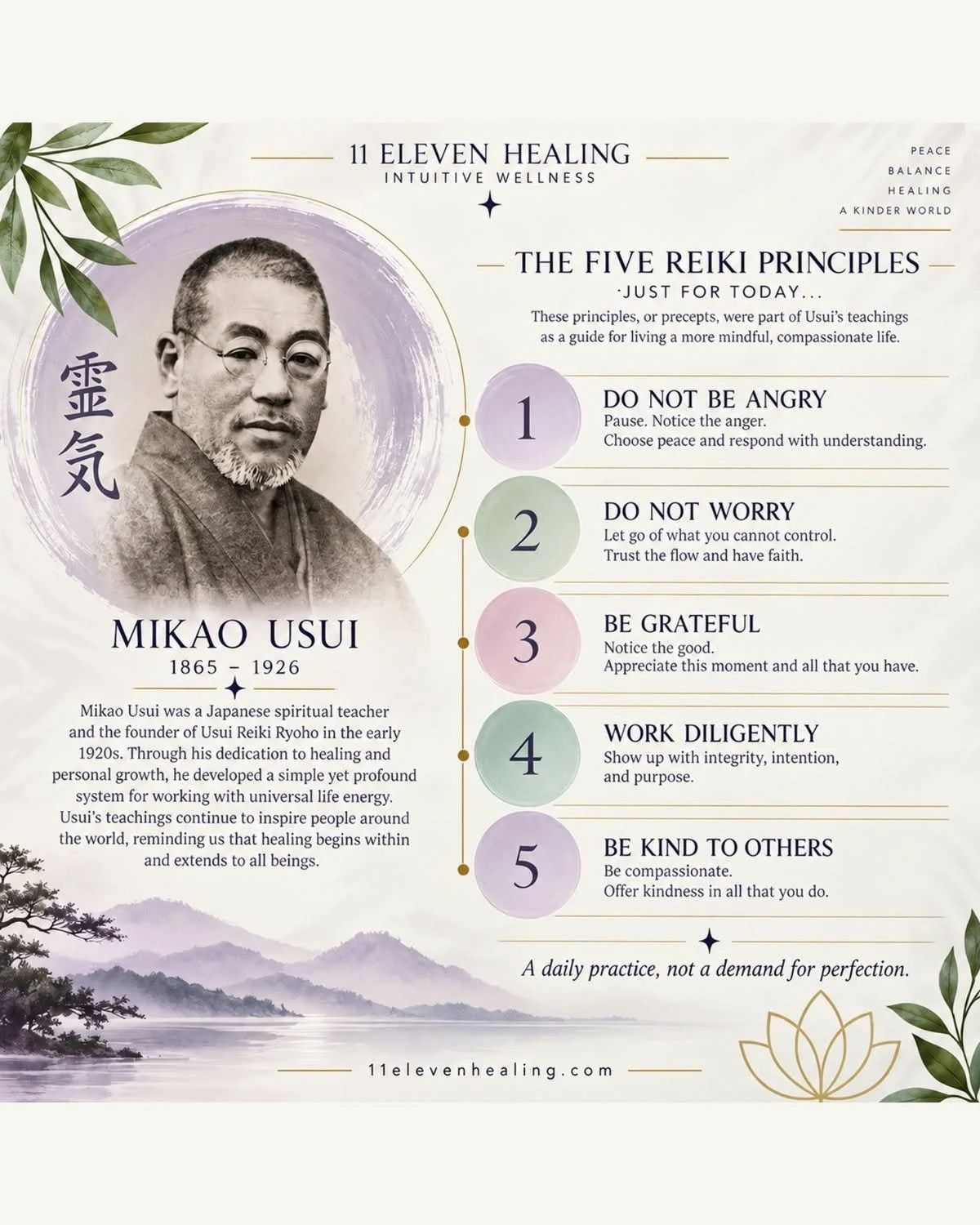
The Five Reiki Principles
The Five Reiki Principles are one of the parts of Reiki that I come back to again and again.
They're simple. And honestly, they're not always easy.
Each one starts with “Just for today.”
I think that's important because it's not asking us to never get angry, never worry, or suddenly become some perfectly peaceful person.
That's not real life.
It's about what we do when those things happen.
Just for today, I will not be angry.
Anger happens. It's part of being human. The question is what we do with it. Can we pause long enough to figure out what's underneath it instead of letting it run the show?
Just for today, I will not worry.
Easier said than done. Our minds love to jump ahead and imagine every possible outcome. This is a reminder to come back to what's actually happening right now.
Just for today, I will be grateful.
Not fake gratitude. Not pretending everything is good when it isn't. Just noticing what is good, what we do have, and what we might normally overlook.
Just for today, I will do my work honestly and diligently.
Show up. Do your part. Pay attention to how you're moving through your day and how you're treating the things you've committed to.
Just for today, I will be kind to others.
And I think we need to include ourselves in that one because most of us are much harder on ourselves than we are on anyone else.
That's really what I take from the principles.
They're not rules for being a better person.
They're reminders to pay attention to how we're living.
And you don't have to be receiving Reiki to practice them.
You can practice them when you're frustrated in traffic.
When someone pushes your buttons.
When you're worried about something that hasn't happened yet.
When you catch yourself being harder on yourself than you would ever be on someone else.
Just for today.
That's enough.
What To Expect In A Session
Reiki is the foundation, but every session starts with the person sitting in front of me.
When someone comes to me for the first time, I want to know what they already know about Reiki, what they believe, what their relationship is with spirituality or religion, and how comfortable they are with intuitive information.
Not everyone comes into a Reiki session with the same beliefs or expectations, and that's okay. I want to understand where you're coming from so I can explain what I'm doing in a way that actually makes sense to you.
Before you arrive, I usually take some time to ground myself and get quiet. I may already have some things written down that have come through intuitively—things I want to bring up during our conversation and see if they connect with what's actually going on in your life.
From there, I do an intuitive chakra scan and take notes on what I’m noticing. Then if comfortable, you get an opportunity to share with me what's going on and what you want to work through.
Depending on what session you choose, I use a variety of cards during the session. Oracle, tarot, spirit animal, angel, chakra, moon themed, etc.
For me, pulling cards isn't just picking a few cards and reading them. I use my intuition while I'm shuffling and often get a sense of when to stop and which cards to pull. I look at the cards themselves—their images, colors, numbers, and symbolism—and then I also look at the traditional meanings in the guidebook.
It's another tool I use to interpret where and why your energy systems are out of balance and where you may need to shift in life.
This is where all the puzzle pieces start to come together. Its where what has come through the different parts of the session starts to connect.
We talk about it together. You get to tell me what makes sense, what doesn't, and what you're experiencing.
Maybe something you've been avoiding comes up and you get emotional. There may be something you’ve been confused about in your life and it all finally makes sense. Maybe you realize there's a pattern you've been repeating that you hadn't really seen before.
We talk through what you're noticing and, when it makes sense, I'll give you something to work on after the session—something practical you can pay attention to or begin shifting in your everyday life.
Then we get to the Reiki.
Once we've talked through the things that need attention, you can get comfortable on the Reiki table.
The traditional Reiki practice is still at the heart of what I do. Depending on the session, the Reiki portion may be around 30–45 minutes, with the rest of our time spent talking, working intuitively, and making sense of what comes up.
This is your time to just be and let the Reiki energy move through your physical and non physical systems.
You can simply relax. Some people feel warmth or tingling. Some feel like their floating and very calm and grounded. Maybe you notice emotions coming up and you get teary. Others may not feel much physically at all. There isn’t a particular experience you’re supposed to have.
And you don’t have to “feel the energy” for Reiki to be meaningful.
Then after the Reiki, we chat a little more.
I'll share anything I noticed during the Reiki, and you can tell me what you experienced. Sometimes there are obvious connections. Sometimes there aren't.
There isn't a right way to experience Reiki.
The session ends with us putting the pieces together and talking about what you can take with you when you leave. It's about helping you become more aware of what's going on with you, so you can start working with it in your own life.